Guides/Design·8 min read·Updated September 4, 2026
Not every tree wraps the same way. Here is how the maples, spruces and birches common across Kitchener-Waterloo and Guelph yards each call for a different lighting approach.
Key takeaways
- 1Deciduous trees like maples show off canopy wraps well in winter since bare branches let the light structure itself become the display, not just a glow through leaves.
- 2Spruces and other evergreens hold their needles year-round, which means lights need to be woven into dense foliage rather than simply wrapped around exposed branches.
- 3Birches, with their pale, papery bark, reflect and scatter light in a way that makes even a modest trunk wrap look brighter than the same wrap on a darker-barked tree.
- 4Tree size, branch structure and height all affect whether a trunk wrap, a full canopy wrap, or a combination of both makes sense for a given tree.
- 5Professional wrapping uses secure, weather-resistant attachment that will not damage bark or girdle branches over the course of a Southern Ontario winter.
Walk through almost any established neighbourhood in Kitchener, Waterloo, Cambridge or Guelph and the tree cover tells a consistent story: mature maples lining the streets, spruces and other evergreens anchoring front yards, and birches, often in clusters of two or three, planted as a lighter accent near entrances or property lines. Each of these trees has a distinct shape, bark, and branch structure, and each one takes to Christmas lighting a little differently. A design that looks stunning on a birch can look thin and underwhelming on a mature spruce, and a wrap style built for a dense evergreen can look overdone on a bare winter maple. Understanding those differences is most of what separates a tree wrap that looks intentional from one that looks like the same technique was applied everywhere without much thought.
Maples: letting bare branches carry the design
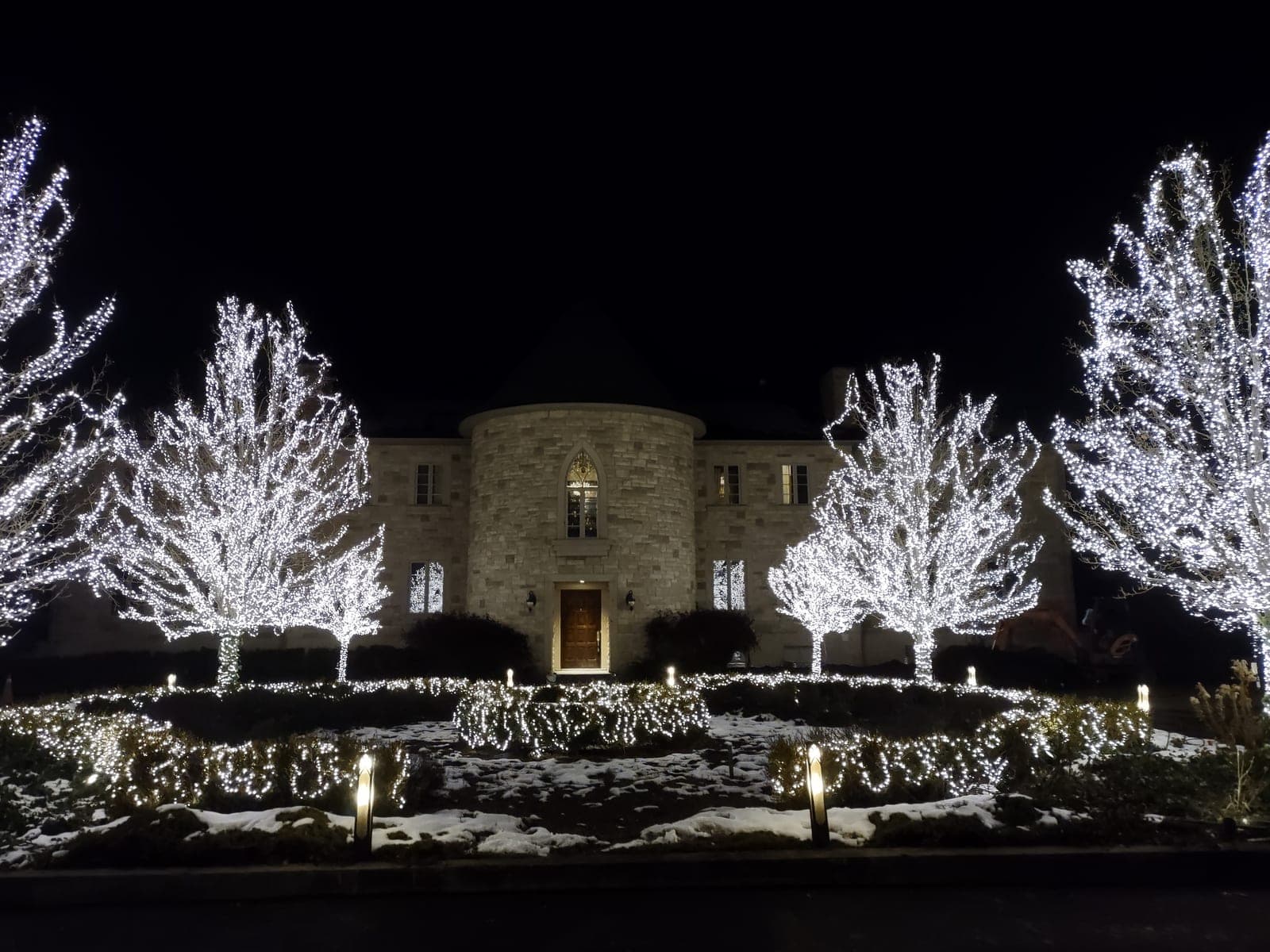
Maples are among the most common street and yard trees across Waterloo Region, and by the time Christmas lighting goes up in November, they have already dropped their leaves for the season. That bare structure is actually an advantage for lighting design rather than a limitation. With no canopy of leaves in the way, a canopy wrap on a maple shows off the actual branch architecture of the tree, with light tracing the same forks and reaches that give the tree its shape in the first place. This tends to produce a striking, almost sculptural look, particularly on mature maples with wide, well-branched canopies.
The technique for a maple canopy wrap generally involves running lights out along the primary branches from the trunk, rather than simply looping them around the outer silhouette of the tree. This draws the eye through the structure of the tree instead of just outlining its edges, and it tends to look more impressive from multiple angles, which matters for a tree standing alone in a front yard where it will be seen from the street, the driveway and the front windows of the house itself. For a smaller ornamental maple, a full canopy wrap is usually achievable in a single visit; a large, mature street maple may call for a partial wrap focused on the lower and mid canopy, since the very highest branches on an older maple can be difficult to reach safely even with proper equipment.
Spruces and evergreens: working with, not around, the needles
Spruces, along with other evergreens like cedars and pines common in the region, present the opposite challenge from a maple. Because they hold their needles through winter, the branch structure underneath is largely hidden, and lights need to be woven into and around the dense foliage rather than simply strung along exposed branches. This generally takes more time per tree than a comparable-sized deciduous tree, since the crew is working with the natural density of the foliage rather than a clear branch skeleton to follow.
The payoff for a well-wrapped spruce is a different kind of effect than a maple provides: rather than tracing a visible branch structure, the light appears to glow from within the tree itself, since the dense needles diffuse and soften the light rather than letting it shine as a sharp point source. This effect works particularly well with warm white LED lighting, which reads as a soft, ambient glow through evergreen foliage rather than the sharper, more graphic look that suits a bare maple's branch structure better. Spruces also tend to hold their shape and fullness for many years, which means a well-planned lighting approach on a mature spruce can essentially become the anchor of a yard's winter display for seasons to come.
Birches: letting pale bark do some of the work
Birches bring something neither maples nor spruces offer: bark that actively reflects and scatters light. The pale, papery bark characteristic of white birches, often planted in small clusters rather than as single specimens, catches and bounces even a modest trunk wrap in a way that makes the tree appear brighter than the same number of lights would look on a darker-barked species. This means birches are often excellent candidates for a focused trunk wrap rather than requiring a full canopy treatment to make an impact, which is useful for smaller properties or budgets where lighting every tree fully is not the priority.
Birches planted in clusters, which is a common landscaping choice throughout Waterloo Region, also lend themselves well to a coordinated multi-trunk wrap, where each trunk in the cluster is wrapped to a similar height and density, creating a unified grove effect rather than treating each trunk as an isolated feature. Because birch bark can be more delicate than the thicker bark of a mature maple or the rough bark of many evergreens, attachment technique matters more here than with hardier species, which is one of the reasons professional installation, rather than a DIY approach with generic clips or tape, tends to produce a better and safer long-term result.
Trunk wrap, canopy wrap, or both
Beyond species, the decision between a trunk wrap, a canopy wrap, or a combination of the two comes down to the size, shape and prominence of the individual tree. A trunk wrap, where lights spiral up the main trunk, works well for smaller ornamental trees, birches in particular, and for any tree where budget or scope calls for a lighter treatment than a full canopy. A canopy wrap extends lighting out along the branches themselves and generally produces a more dramatic, fuller effect, which suits larger, more prominent trees that anchor a front yard or line a driveway.
Combining both, a trunk wrap that transitions into a partial canopy wrap on the lower branches, is a common middle ground for medium-sized trees where a full canopy wrap would be more scope than the tree or the budget calls for, but a trunk-only wrap would underuse a tree with an otherwise attractive branch structure. Our team typically walks a property, looks at each tree's size, species and position relative to the house, and recommends the approach that will look most proportional to the property as a whole, rather than applying the same treatment to every tree regardless of size or species. Full detail on the range of tree lighting options is available at /services/tree-lighting-services.
How height and access shape the plan
Mature trees in established Waterloo Region neighbourhoods can be considerably taller than what a homeowner can safely reach with a standard ladder, and this is one of the main reasons tree wrapping benefits from professional equipment and experience rather than a weekend DIY project. Taller maples and spruces in particular often require proper lift equipment to wrap safely and completely, especially for canopy work that extends into the upper reaches of the tree. Attempting this kind of height with a household ladder is both a safety risk and likely to produce an incomplete wrap that only covers what is reachable from the ground.
This is also where insurance and professional liability matter. Classic Christmas Lighting is fully insured, which covers work at height around a homeowner's property, something that matters when equipment, ladders or lifts are being used close to a house, driveway or neighbouring property line. For homeowners with particularly large or tall specimen trees, mentioning the tree's approximate height and location during the initial quote conversation helps our team plan for the right equipment before the crew arrives.
Protecting the tree itself
A wrap that looks good but damages the tree is not a good outcome for anyone, and this is particularly relevant for younger or more delicate trees, birches especially, where bark can be more easily scarred by improper attachment. Professional wrapping uses attachment methods designed not to girdle branches, cut into bark, or leave marks that persist after the lights come down in January. This matters as much for a tree's long-term health as it does for how the wrap looks this season, since a tree that gets wrapped every year for many years benefits from consistent, careful handling rather than whatever method happens to be quickest.
Removal technique matters just as much as installation. Lights left up too long, or removed carelessly by pulling rather than unwinding, can damage new spring growth or leave wire fragments tangled in branches that surface again the following winter as a surprise during the next wrap. Our full-service approach includes proper takedown as part of the same seasonal package as installation, which avoids this kind of accumulated damage over multiple seasons.
Bringing it together across a property
Most properties in Kitchener, Waterloo, Cambridge, Guelph, Hamilton, Woodstock and Stratford have more than one tree species in the yard, which means a well-designed display often uses different techniques for different trees rather than a single approach applied uniformly. A front yard with a mature maple, a spruce anchoring one corner, and a cluster of birches near the entrance might see a full canopy wrap on the maple, a denser woven treatment on the spruce, and a coordinated trunk wrap across the birch cluster, all tied together with a consistent light colour and coordinated with the roofline lighting and any entrance decor elsewhere on the property. This kind of coordinated, species-aware approach is what our tree lighting service is built around, and it is worth discussing tree by tree during the initial quote conversation rather than assuming one technique fits every tree on the lot.
Getting a tree lighting plan started
For homeowners planning tree lighting as part of a broader Christmas display, or as a standalone feature, the best starting point is a conversation about what is actually in the yard. Mentioning tree species, approximate height, and how many trees are being considered during a quote request at /contact helps our team plan the right technique and equipment ahead of time. A free quote is available for properties throughout Kitchener, Waterloo, Cambridge, Guelph, Hamilton, Woodstock and Stratford, with no travel charges within that service area. Call (226) 476-2038 or reach out through /contact to talk through what a wrap would look like for the specific trees on your property.
Frequently asked questions
Why does a maple wrap look different from a spruce wrap?
Maples drop their leaves before Christmas lighting goes up, so a canopy wrap traces the bare branch structure of the tree. Spruces keep their needles year-round, so lights are woven into the foliage and produce a softer, glowing effect rather than a visible branch pattern.
Do birches need a full canopy wrap to look good?
Not usually. Pale birch bark reflects and scatters light effectively, so a focused trunk wrap often makes a strong visual impact without needing a full canopy treatment, which also suits smaller budgets or properties.
Can tall trees be wrapped safely?
Yes, with the right equipment. Mature trees that exceed standard ladder height typically require lift equipment for a safe, complete wrap, particularly for canopy work in the upper branches. Mentioning tree height during the quote conversation helps plan for this in advance.
Will wrapping damage my tree?
Professional wrapping uses attachment methods designed to avoid girdling branches or scarring bark, and proper takedown avoids leaving wire fragments behind. This matters for the tree's long-term health across multiple seasons of wrapping.
Can different trees on my property get different wrap styles?
Yes. Most properties benefit from a species-aware approach, such as a canopy wrap on a maple, a woven treatment on a spruce, and a trunk wrap on birches, all coordinated with a consistent light colour.
How do I know if my tree needs a trunk wrap, canopy wrap, or both?
This depends on the tree's size, species and prominence in the yard. Our team assesses each tree during the quote process and recommends the approach that will look most proportional to the property as a whole.
Free quote
Want us to just handle it?
Send a photo of the house and we will come back with a price within a business day.
Keep reading
Design · 7 min
LED vs Incandescent Christmas Lights for Ontario Winters
Warm incandescent glow or crisp, efficient LED. Here is how the two technologies actually hold up through a Waterloo Region winter, and how the choice shapes the finished look.
Design · 7 min
Garland, Wreaths and Bows: Front Entrance Decorating Ideas
A roofline full of lights sets the tone, but the front entrance is what visitors actually walk up to. Here is how garland, wreaths and bows pull a Waterloo Region display together.
Planning · 8 min
What to Expect From a Professional Christmas Light Install in Waterloo Region
From the first phone call to the January takedown, here is what actually happens when a professional crew installs your Christmas lights in Kitchener-Waterloo, Cambridge or the surrounding towns.