Guides/Design·7 min read·Updated September 4, 2026
Warm incandescent glow or crisp, efficient LED. Here is how the two technologies actually hold up through a Waterloo Region winter, and how the choice shapes the finished look.
Key takeaways
- 1LED and incandescent lights both have a place in Christmas lighting design, but they behave differently once temperatures drop and stay down through a Waterloo Region winter.
- 2LED bulbs use a fraction of the electricity of incandescent bulbs and generate very little heat, which affects both running cost and how they interact with snow.
- 3Incandescent bulbs produce a warmer, softer glow that some homeowners prefer, but the bulbs and wiring are generally more fragile through repeated freeze-thaw cycles.
- 4Commercial-grade LED lighting is built with sturdier housings and connections designed for extended outdoor exposure, which is why it is the standard product supplied for professional installations.
- 5The right choice depends on the look you want and the property itself, and it is something to work through in the design conversation rather than decide on your own before calling.
Every fall, the same question comes up in design conversations across Kitchener, Waterloo and Cambridge: should the display use LED lights or the older-style incandescent bulbs, and does it actually matter which one goes up on the roof. It matters more than most homeowners expect, and not just for the electricity bill. LED and incandescent bulbs behave differently once a Waterloo Region winter sets in, with its mix of wet snow, freeze-thaw swings and the occasional deep cold stretch, and that difference shows up in everything from how the display looks on a dark December evening to how well it survives until January takedown.
How the two technologies actually differ
Incandescent Christmas lights work the way they always have, using a small filament that heats up and glows when electricity passes through it. LED lights use a semiconductor that emits light directly, without heating a filament, which is the source of most of the practical differences between the two. LEDs use a small fraction of the power an equivalent incandescent bulb draws, run much cooler, and last considerably longer before a bulb needs replacing. Incandescent bulbs, in exchange, produce a light quality that many people associate with a more traditional, warmer Christmas look, since the filament produces a broader, softer spectrum of light rather than the more focused output of an LED.
How each holds up in the cold
Cold weather affects both technologies, but in different ways. Incandescent bulbs and their wiring can become more brittle in extreme cold, and the filaments themselves are more prone to failure from vibration, such as wind gusts across an exposed roofline. LED bulbs are generally more resilient to cold temperatures and vibration, since there is no fragile filament to break, though the plastic housings and wiring still need to be built for sustained outdoor exposure. Where LEDs sometimes draw a comment is around snow, since their lower heat output means a coating of light snow can sit on the bulbs rather than melting off quickly the way it might with a warmer-running incandescent strand. In practice, this is rarely a real problem, since most Waterloo Region snow either brushes off in the wind or melts within a day, and it is a minor trade-off against the much larger gains in efficiency and durability.
Energy use adds up over a long season
A Christmas display in this region is typically running for a stretch that spans November lighting-up events through the new year, often several hours every evening. Over that many weeks, the wattage difference between LED and incandescent lighting adds up meaningfully on the electricity bill, particularly for a longer roofline, a large tree wrap, or a bigger commercial property with multiple buildings. LED lighting draws a small fraction of the power of an equivalent incandescent display, which is one of the main reasons commercial and larger residential installations have shifted toward LED almost universally over the past decade.
Durability through a full Ontario season
Beyond a single cold night, a Christmas display in Waterloo Region needs to survive weeks of freeze-thaw cycling, the occasional ice storm, wind events, and heavy wet snow loads on branches and rooflines. This is where the gap between consumer-grade and commercial-grade lighting matters more than the gap between LED and incandescent on their own. A cheap LED strand from a big-box store can still fail partway through the season if the wiring and connectors are not built for sustained outdoor exposure, just as a cheap incandescent strand can. Commercial-grade LED lighting, the kind supplied with a professional installation, is built with sturdier wiring, better-sealed connectors and housings designed specifically to handle a full winter outdoors, which is a meaningful step up from either consumer-grade option regardless of bulb type.
Bulb lifespan over the course of a season and beyond
LED bulbs are rated for a considerably longer working life than incandescent bulbs, often measured in tens of thousands of hours compared to a much shorter span for a typical incandescent bulb. Over a single Waterloo Region season, this rarely matters much on its own, since even an incandescent strand can usually make it from November install to January takedown without much trouble under normal conditions. Where the difference shows up is in the failure pattern within a strand. Many older-style incandescent strands are wired so that one failed bulb can affect the section around it, while individual LED bulbs on a professional-grade strand are typically wired to fail independently, so one weak bulb does not take down a whole run of lights. That difference is part of why a mid-season maintenance check can address a single failed LED bulb quickly, rather than tracing a wiring issue across an entire section.
A safety consideration worth knowing about
Because LED bulbs generate very little heat compared to incandescent bulbs, they are considered a safer choice for applications where the bulbs sit close to dry material for weeks at a time, such as wrapped around the trunk and branches of a real tree, tucked into dense garland, or wound tightly around dry evergreen boughs. Incandescent bulbs run warm enough that manufacturers have long recommended more caution in these tighter applications. This is one of the quieter reasons LED has become the standard for tree wrapping and garland work across the region, alongside the more commonly discussed advantages around energy use and durability.
How the choice affects the finished look
Beyond durability and running cost, LED and incandescent lighting produce a genuinely different visual effect, and this is often the deciding factor for homeowners once the practical trade-offs are explained. Warm white LED bulbs are now close enough in colour temperature to traditional incandescent that most people cannot tell the difference from the street, which has made warm white LED the default choice for homeowners who want that classic glow without the running cost or fragility of true incandescent. Multicolour LED displays tend to look crisper and slightly more saturated than older-style multicolour incandescent, which some homeowners prefer and others find a touch less nostalgic. For rooflines outlined in C9 bulbs, a common choice throughout Kitchener and Waterloo subdivisions, the bulb size itself has more visual impact than the underlying technology, though LED C9 bulbs hold their brightness more consistently across a long roofline than incandescent.
What this means for different property types
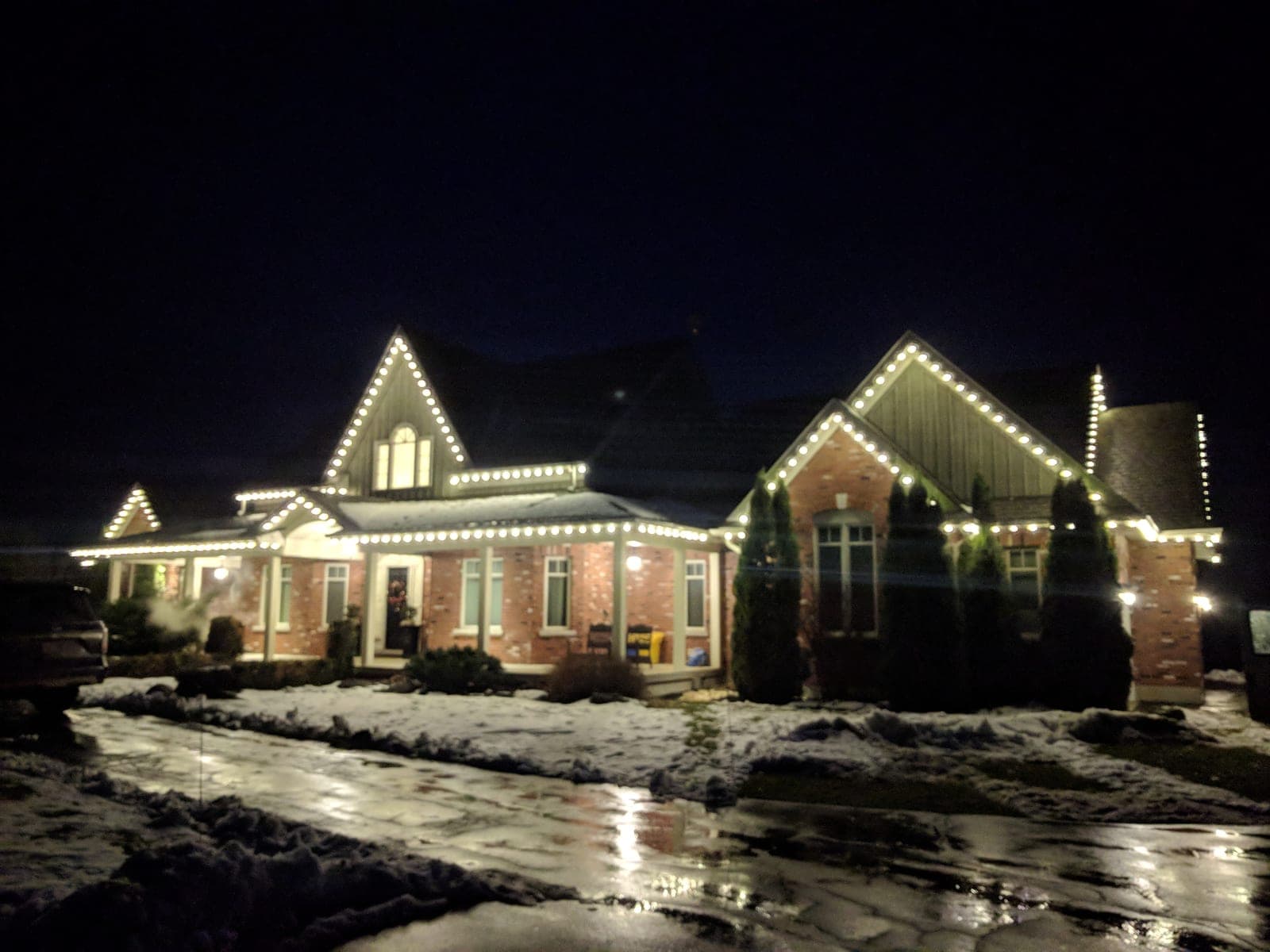
For a brick or stone home in a Kitchener or Cambridge subdivision, warm white LED C9 lighting along the roofline is by far the most common choice, striking a balance between the traditional look homeowners want and the practical demands of an Ontario winter. For a tree wrap, whether it is a mature spruce on a farmhouse property near Wellesley or an ornamental tree by a front entrance in Waterloo, LED mini lights are almost always used, since they run cool enough to be safely wrapped tightly around branches for weeks at a time. Commercial properties, including storefronts in uptown Waterloo or downtown Kitchener and multi-building tech campuses, lean toward LED almost exclusively, both for the energy savings across a large footprint and for the more consistent brightness across long runs of lighting. Details on how residential and commercial designs are approached differently are covered at /services/christmas-lighting-for-homes and /services/christmas-lighting-for-businesses, and tree-specific wrapping techniques are covered at /services/tree-lighting-services.
Making the decision for your property
For most homeowners and businesses in Waterloo Region, the practical case for LED is strong enough that it has become the default rather than a special request, and it is the product Classic Christmas Lighting supplies as part of every installation. That said, the exact bulb style, colour temperature and size are all still design decisions worth discussing, since a warm white LED C9 roofline looks quite different from a cooler white LED strand or a multicolour design, even though all three share the same underlying technology. That conversation happens as part of the design process after an initial quote request through /contact or a call to (226) 476-2038, so there is no need to settle on bulb style before reaching out. Whatever the final look, the underlying commercial-grade LED product stays the same reliable baseline across every property Classic Christmas Lighting installs throughout Kitchener, Waterloo, Cambridge, Guelph, Hamilton, Woodstock and Stratford.
Frequently asked questions
Do LED Christmas lights actually look as warm as incandescent bulbs?
Warm white LED bulbs are now designed to closely match the colour temperature of traditional incandescent light, and most people cannot tell the difference from the street. It has become the standard choice for homeowners who want a classic warm glow.
Do LED lights struggle with snow buildup compared to incandescent?
LED bulbs run cooler, so a light dusting of snow can sit on them slightly longer than it would on a warmer incandescent bulb. In practice this is a minor cosmetic detail rather than a functional problem, and most snow clears within a day.
Are LED lights actually more durable through an Ontario winter?
Generally yes, since there is no fragile filament to fail from cold or vibration. Durability also depends heavily on build quality, which is why commercial-grade LED product is used for professional installations rather than consumer-grade strands.
Does LED lighting really save meaningful money over a season?
Over several weeks of nightly use, LED lighting draws a small fraction of the electricity that an equivalent incandescent display uses, and the difference is more noticeable on longer rooflines or larger commercial properties.
Can I request incandescent-style lighting instead of LED?
The design conversation covers bulb style and colour temperature preferences. Warm white LED is supplied as the standard commercial-grade product because of how it performs through the season, and that can be discussed as part of your quote at /contact.
Is LED the right choice for tree wrapping too?
Yes. LED mini lights run cool enough to be wrapped closely around trunks and branches for weeks without the heat concerns of incandescent strands. More detail is available at /services/tree-lighting-services.
Free quote
Want us to just handle it?
Send a photo of the house and we will come back with a price within a business day.
Keep reading
Design · 7 min
Garland, Wreaths and Bows: Front Entrance Decorating Ideas
A roofline full of lights sets the tone, but the front entrance is what visitors actually walk up to. Here is how garland, wreaths and bows pull a Waterloo Region display together.
Design · 8 min
Wrapping Trees with Lights in Waterloo Region: Maples, Spruces and Birches
Not every tree wraps the same way. Here is how the maples, spruces and birches common across Kitchener-Waterloo and Guelph yards each call for a different lighting approach.
Planning · 8 min
What to Expect From a Professional Christmas Light Install in Waterloo Region
From the first phone call to the January takedown, here is what actually happens when a professional crew installs your Christmas lights in Kitchener-Waterloo, Cambridge or the surrounding towns.